







Unable to run for the presidency but too powerful to ignore, the ex-deputy president is reshaping Kenya’s alliances from the outside, with Ruto, Raila and Kalonzo all calculating around him.
A power struggle between Gachagua and Matiang’i is testing Kenya’s united opposition, as both men position themselves to challenge President Ruto in 2027.
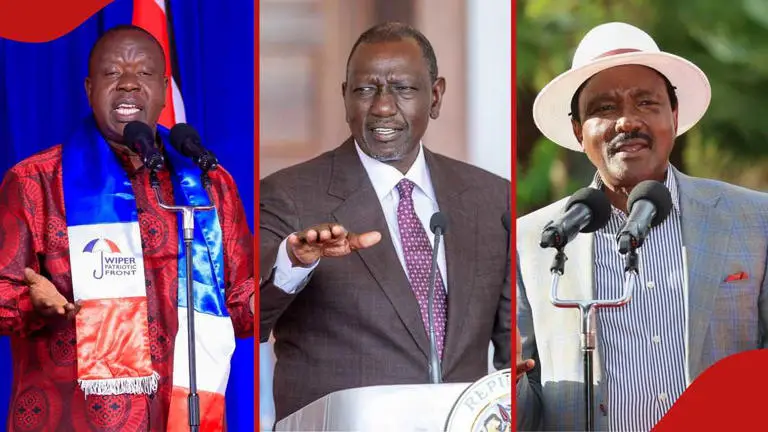
From one perspective, a divided opposition hands the incumbent a clear advantage. Kenya’s electoral history shows that fractured opposition movements often struggle to translate public dissatisfaction into electoral victory. If the current divisions persist, President Ruto could find himself cruising toward 2027 with minimal resistance, benefiting from incumbency, state machinery, and a splintered political alternative.
When Rigathi Gachagua landed at Nairobi’s Jomo Kenyatta International Airport on Thursday, the reception looked less like a welcome party and more like a political declaration. Thousands of supporters defied police cordons and paralysed traffic, clashing with security forces and turning busy Mombasa Road in the capital into a battlefield of rocks, teargas and chants.
The spectacle highlighted a paradox. Just 10 months after his impeachment as deputy president, Gachagua has repositioned himself as a disruptive force in Kenya’s 2027 election cycle.
His October 2024 removal from office might have ended the careers of most politicians. Instead, it gave Gachagua a new platform. Free from cabinet discipline, he formed the Democracy for Citizens Party (DCP), and has since pulled MPs, senators and grassroots operatives away from President William Ruto’s ruling United Democratic Alliance (UDA).
His message that Mount Kenya was “misled” into backing Ruto in 2022 and must now correct that mistake has been consistent.
That appeal builds on the central role Gachagua played in Ruto’s ascent. In 2022, Gachagua’s mobilisation secured a majority of the Kikuyu vote, compensating for Ruto’s weaker showing in other regions. Many insiders believe Ruto had preferred to run with current Deputy President Kithure Kindiki, but Gachagua’s grassroots muscle made him the indispensable choice.
“Gachagua knows he cannot win the presidency outside his Mount Kenya backyard,” says analyst Kevin Ochol, arguing that within that region, however, his influence is critical. He tells The Africa Report that whoever hopes to challenge Ruto in 2027 will need Gachagua on their side or find a way to blunt Ruto.
The crucial Mount Kenya equation
Mount Kenya remains Kenya’s most vote-rich bloc. It has rarely produced opposition leaders. Instead, it has historically delivered decisive blocs to whichever coalition appeared most likely to win.
In 2022, Gachagua’s mobilisation did that for Ruto; now he insists that the region was betrayed, arguing that Ruto has neglected its economic interests. From Nyeri to Kiambu, Gachagua has branded himself the “gatekeeper” of central Kenya, a title that forces every major player, including Ruto, Raila Odinga’s allies and Kalonzo Musyoka, to calculate around him.
READ MOREKenya: Ruto, Gachagua devise parallel political strategies to win Mt Kenya support
“From the voting patterns in Kenya, his supporters will vote for whoever he supports,” Ochol notes. That, he adds, makes Gachagua indispensable in coalition arithmetic.
But the same ethnic anchoring limits his national appeal. To critics, Gachagua remains a tribal leader, unwilling or unable to articulate a vision beyond Kikuyu interests. Opposition figures outside his base worry that partnering with him could energise Mt Kenya but alienate swing regions in western Kenya or the coast.
Riding anti-Ruto sentiment
President Ruto’s declining popularity is working in Gachagua’s favour. Elected as the self-styled “hustler president” who would uplift ordinary Kenyans, Ruto is now accused of abandoning them. Soaring food and fuel prices, a punishing tax regime and perceptions of arrogance in the State House have eroded his credibility.
Ruto’s grip on parliament and allegations of bribery in the impeachment vote made him look more like a victim than a villain
Gachagua has seized that moment. He tells audiences that he, too, has been targeted by the state, hounded by intelligence agencies, harassed by police and toppled by a vindictive parliament. That narrative of persecution mirrors the grievances of many Kenyans who feel squeezed by the government. In him, many people see a victim and a survivor of a vindictive regime.